

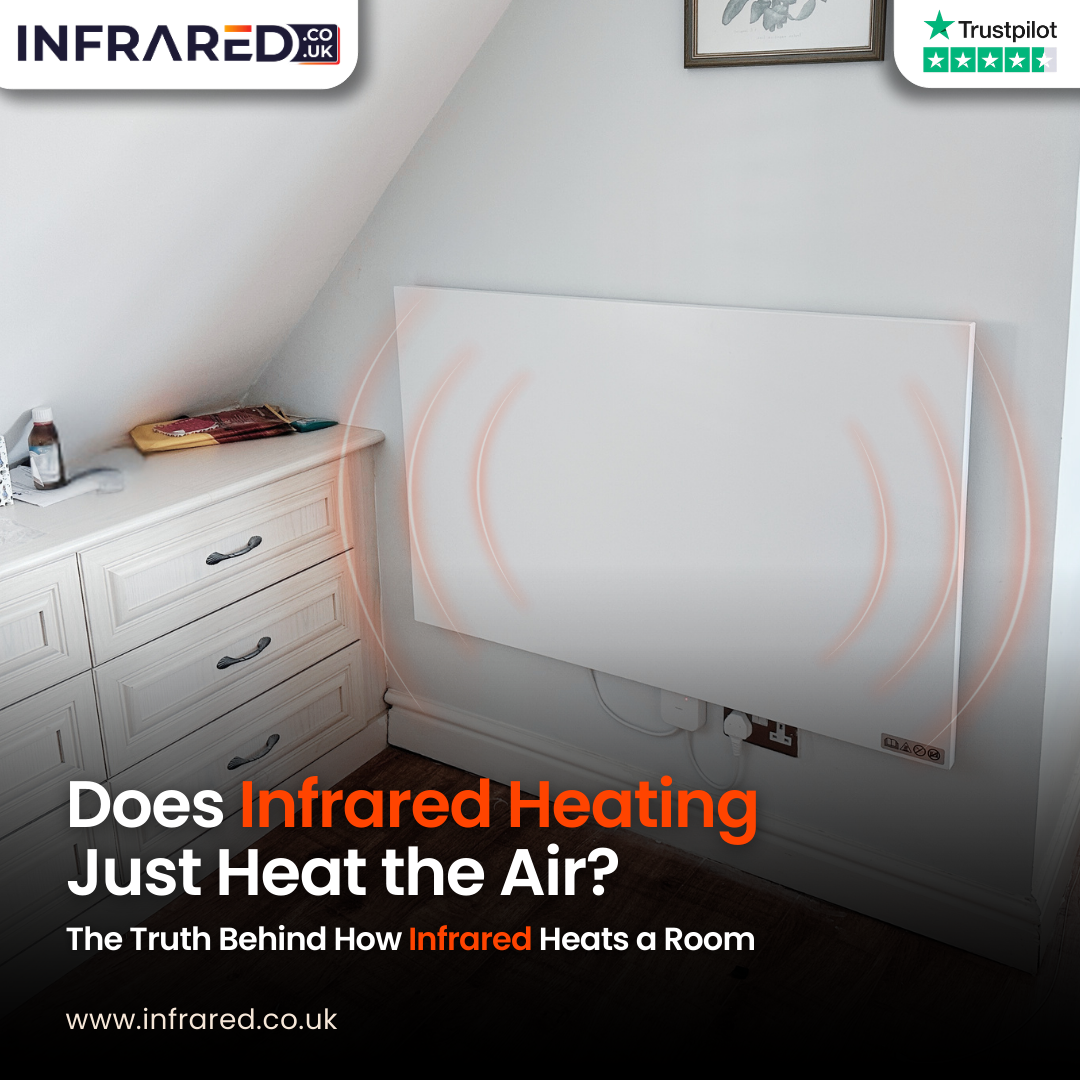
Does Infrared Heating Just Heat the Air? The Truth About How Infrared Warms a Room
Infrared heating has quickly become one of the most popular alternatives to conventional central heating and older electric convection systems. Even so, one question still comes up time and time again online:
Does infrared heating only warm objects and surfaces, or does it heat the air too?
This is one of the most common misunderstandings around infrared heating, and it often concerns people who are familiar with radiators, storage heaters, or fan heaters that heat the air directly. Some even assume you need to stand directly in front of an infrared panel to feel any benefit, or that the rest of the room remains cold.
In truth, that is not how it works at all.
This article explains exactly how infrared heating warms a whole room, why the room often feels warmer than it would with convection heating at the same temperature, and why infrared systems create a more even and comfortable warmth, often with much lower running costs.
Infrared Heating vs Convection Heating: What’s the Difference?
Before looking at how infrared warms a room, it is useful to understand how traditional heating systems operate.
How Convection Heating Warms a Room
Convection heating, used by radiators, storage heaters, fan heaters, and most standard electric heaters, works by warming the air. That heated air rises, cools, circulates, and is then reheated again and again. This leads to several familiar issues:
-
Stratification: warm air near the ceiling, colder air at floor level
-
Drafts and uneven cold spots
-
Dust and allergens moving around the room
-
Longer warm-up times
-
Higher running costs due to constant reheating
This is why many properties heated by convection can feel stuffy, dry, or uneven in temperature.
How Infrared Heating Works
Infrared heating works in a completely different way. Rather than depending on moving air, infrared panels emit gentle far infrared radiant heat that warms the walls, floors, furniture, surfaces, and people within the room.
Those warmed surfaces then slowly give heat back into the space, helping distribute warmth more evenly. This creates a steadier, longer-lasting heat than a convection-based system.
The result:
-
No cold spots
-
No drafts
-
No unnecessarily overheated air
-
A more natural, soothing warmth
-
Comfort at a lower perceived temperature
-
Reduced energy use thanks to lower wattage heating
The main misunderstanding is this: many people think infrared only heats objects and not the room itself, and that simply is not true.
Does Infrared Heating Warm the Air?
Yes, infrared heating does warm the air, but it does so in a more efficient way than convection heating.
Because infrared warms objects and surfaces first, many people assume the air never gets warm. In reality, the air does warm up, just through a more gradual and effective process.
The Secondary Heating Effect
Far infrared warms the surfaces in the room, and those surfaces then re-radiate heat and gradually raise the air temperature around them. This happens more slowly than convection, but it is far more energy-efficient. The room retains warmth for longer because its thermal mass has absorbed and stored that heat.
That is why infrared-heated spaces often remain warm well after the heating has switched off, unlike convection systems where warm air can disappear very quickly.
Why Infrared Feels Warmer at Lower Temperatures
What is even more interesting is that your body often feels warmer at a lower air temperature when using infrared heating.
Infrared heat warms your body and the surrounding surfaces directly, increasing what is known as the perceived temperature. In practice, a room at 18°C with infrared heating can often feel more like 20–21°C with conventional central heating.
That means:
-
Quicker comfort
-
Less energy needed
-
Lower ongoing energy costs
So yes, infrared does warm the air, it simply does so in a more efficient, gradual, and less wasteful way.
Does Infrared Heating Warm the Whole Room?
Another common myth is that infrared heaters only work if you stand directly in front of them. People often imagine infrared heat as being like a fireplace, where the warmth is immediate and highly directional.
But far infrared panels behave very differently to glowing quartz near-infrared heaters.
How Infrared Heat Spreads Around a Room
Far infrared moves around the room using a gentle bounce effect. The waves reflect softly from surfaces, floors, ceilings, and objects, spreading throughout the space until the whole room reaches temperature. The result is highly consistent warmth from wall to wall and from floor to ceiling.
What an Infrared-Heated Room Feels Like
Many people expect an infrared-heated room to feel cold unless they are directly in front of the panel. In reality, that is not the case. When you enter a room heated by far infrared:
-
The surfaces are already warm
-
The room holds heat for longer
-
The air has warmed naturally
-
The space feels balanced and comfortable
It feels very similar to stepping into a room heated by central heating, but without the stuffiness, dry air, or constant temperature swings.
Why Infrared Heating Feels Better Than Convection Heating
Infrared heating creates a type of comfort that feels noticeably different to radiators or traditional electric heaters.
More Even Heat Throughout the Room
Because infrared warms surfaces, the room itself becomes a kind of thermal store. This helps remove common problems such as:
-
One part of the room feeling warmer than another
-
Warm air gathering at ceiling level
-
Cold floors or chilly corners
Less Stuffiness and Improved Air Quality
Because infrared does not rely on heating the air directly or creating air movement, it can help reduce:
-
Dust circulation
-
Dry air
-
Airborne allergens
-
Humidity fluctuations
Many people with asthma or allergies say infrared heating feels far more comfortable.
Reduced Damp and Mould Risk
Cold surfaces are one of the main causes of condensation and mould. Because infrared warms those surfaces directly, it can help stop moisture from settling, making it ideal for bathrooms, holiday lets, older properties, and homes with poor insulation.
Is Infrared Heating Cheaper to Run?
Saving energy is one of the biggest reasons people move to infrared heating.
Lower Wattage Requirements
A typical 12 m² room may often need:
-
1.2–1.8 kW with electric convection heating
-
600–900 W with infrared panels
That is because infrared heats the room’s thermal mass, rather than constantly reheating air that easily escapes.
Faster Comfort Means Shorter Heating Times
Because you feel warm more quickly, the heaters usually run for less time. Shorter heating cycles can lead to significantly lower electricity usage.
Better Heating Control and Zoning
Infrared systems work especially well with:
-
Smart thermostats
-
Room-by-room zoning
-
Scheduling
-
Energy monitoring
This gives you much greater control than storage heaters or older radiators, where energy is often wasted.
Do You Need to Stand in Front of an Infrared Heater to Feel Warm?
Absolutely not.
This myth usually comes from people confusing far infrared heating panels with glowing near-infrared heaters. Genuine far infrared panels distribute heat evenly throughout the room, so you feel warm wherever you are.
Real-World Example of How Infrared Heating Works
Picture a ceiling-mounted infrared panel in a living room. The panel warms:
-
The floor
-
The sofa
-
The walls
-
The coffee table
-
The people in the room
Each of these then gives off gentle, steady warmth back into the space.
Whether you are sitting by the door, relaxing on the sofa, or working at a desk, the room feels evenly and naturally warm.
Infrared Heating vs Storage Heaters and Traditional Electric Heating
If you are comparing heating systems, it helps to understand how infrared compares with other electric options.
Infrared vs Storage Heaters
Storage heaters work by heating bricks overnight and releasing that heat gradually. They:
-
Are inefficient
-
Create temperature fluctuations
-
Can be costly to run
-
Lose heat at the wrong times
-
Are hard to control
Infrared heating, on the other hand, gives you precise control, quick comfort, and lower running costs.
Infrared vs Fan Heaters and Panel Heaters
Fan heaters and convection panel heaters can warm the air quickly, but that warmth escapes just as quickly too. They may be useful for short bursts of heat, but they are not especially efficient for full-room or whole-home heating.
Infrared provides a deeper, more lasting warmth while using less energy.
Infrared vs Central Heating Radiators
Radiators heat the air first, which can lead to uneven temperatures and greater heat loss. Infrared delivers a more balanced and comfortable warmth and can operate at a lower perceived temperature.
Conclusion: Does Infrared Heating Heat the Air and the Room?
The belief that infrared heating does not warm the air is a myth based on a misunderstanding of how the technology works. In reality, what happens is much more efficient:
-
Infrared warms people and surfaces directly
-
Those surfaces then warm the air gradually and naturally
-
The room feels warm throughout, not only in front of the panel
-
You stay comfortable at a lower thermostat setting
-
The heat feels more even, stable, and pleasant
Whether you are replacing old storage heaters, upgrading outdated electric heating, or searching for an efficient alternative to central heating, infrared heating offers a modern, comfortable, and energy-efficient solution.
Frequently Asked Questions About Infrared Heating
Does infrared heating only heat objects?
No. Infrared heating warms surfaces and people first, and those warmed surfaces then gradually heat the air in the room as well.
Does infrared heating make a room feel warm?
Yes. Infrared heating creates a balanced, comfortable warmth across the whole room, not just in front of the panel.
Is infrared heating better than convection heating?
In many properties, yes. Infrared heating can provide more even warmth, lower running costs, less dust circulation, and improved comfort compared to traditional convection systems.
Is infrared heating good for old houses?
Yes, especially because it warms surfaces directly, which can help reduce condensation, damp, and mould on colder walls.


